With CONCEPT's unique package of attractively priced LED walls, suspensions, video controllers and matching services, any provider of IT, illuminated advertising and shopfitting can now easily enter the rapidly growing market for LED video walls. The FutureSource Study puts the growth at 29 percent per year! What's new with us is the option to rent a LED wall for a monthly fee without risk – including warranty extension.
Areas of application: Home cinema, booth construction, shopfitting with digital signage, lobbies, bars, canteens, stadiums, events & concerts, façade advertising (DooH), airports, railway stations, universities, control rooms & the like.
Request a price list and information brochure from our LED experts NOW at LED@concept.biz or call us at +49 (89) 961 6085-26!
What is the Difference Between an LED Wall and an LCD Wall?
With an LED wall, visible frames between displays are a relic of the past. It can also be used to create completely new visual experiences – such as column cladding and curves. In combination with suitably created videos, they captivate every person looking at them. Luminosities of up to 6,000 cd/m² are possible – perfect for facades or concerts. CONCEPT International ensures that the LED selection perfectly matches the customer's objective.
Components of an LED Wall
The video walls are seamlessly assembled from LED displays. Each LED display, in itself, has an internal power supply (possibly another, redundant one) and two (sometimes four) LED modules or tiles with video receiver cards held onto the front of the LED display body with strong magnets. A video controller feeds the individual video receiver cards – ensuring that each display is properly addressed by an HDMI input signal. The brightness – usually adaptive via a brightness sensor – and position of the individual displays are also set this way. When replacing a module, it is always possible to individually adjust the brightness of the new module to that of the others. We also offer remote maintenance that monitors other "life data" such as temperature, etc.
Overview and Selection of the Right LED Wall Type
There are:
“Standard” video walls – that is, aluminum enclosures (closed at the back) joined seamlessly together, which are then fitted with LED modules. Applications include retail, control and operations planning, home theater, and free-form wall designs such as column cladding, door frames, curved walls, etc.
Special “Butterfly” design: this double-sided video wall consists of a (thin) aluminum housing, which is equipped with LED modules on both sides. Typical applications include free-hanging installations in stores or shop windows.
Mesh video screens – the latest trend: semi-transparent, relatively flexible, semi-translucent mesh screens that can be hung (lightweight!) or adhered to the front or back of glass, thereby transforming storefronts into video walls. These can also be removed from the glass—in some cases without causing damage.
Rental video walls consist of aluminum tube frames that can be easily linked together using quick-release fasteners—typically, only the top frame is secured, and all others are attached. They are primarily used in the concert industry. Most are also equipped with an IP protection rating for outdoor use.
Types of LED Modules
The technology used to mount individual LEDs onto a circuit board - thus creating an LED module - is important, and there are pros and cons. Here, we provide a brief overview of the SMD, GOB, COB, RGBG/virtual pixeland MIP technologies:
SMD (Surface Mount Device): With SMD encapsulation technology, each LED pixel—which, strictly speaking, is composed of three individual LEDs in the primary colors RGB (red/green/blue)—is mounted on the circuit board as a single module (in a housing). The LED pixels thus sit on the circuit board like small blocks spaced apart from one another—this is the oldest and most cost-effective technology, which is particularly popular for low-resolution, high-brightness modules, as heat dissipation works best here.
COB (Chip on Board): Here, the individual RGB LEDs are cast side by side into a single unit directly during the manufacturing process of an LED module—resulting in a smooth surface. Production costs have since become slightly lower due to the elimination of an additional step, and heat dissipation via the connection contacts on the back also works well. COB is therefore ideal for applications requiring high resolution and mechanical robustness against touch, cleaning, etc.—as is required in retail settings or for digital whiteboards in universities and hotels.
GOB (Glue on Board): In the GOB process, a protective layer of epoxy resin is applied to modules manufactured using cost-effective SMD technology, making them more resistant to external factors such as moisture and dust. This type of sealing provides good protection for LEDs, increasing their lifespan and reliability. Priced between SMD and COB, the contrast and brightness are slightly lower than with COB, and the color of the epoxy resin may change over time when exposed to strong sunlight.
RGBG or virtual pixels: This technology is not directly an alternative to the technologies mentioned above, as it merely concerns the arrangement of the individual color LEDs: instead of one, two G (green) LEDs (at half brightness) are now used. Manufacturing typically occurs in a single process—i.e., COB (“Super-COB”) or SMD. The resulting square arrangement without gaps allows for higher contrast. Thanks to special control algorithms, this technology can convey more color information than the number of physically present individual pixels. To achieve this, additional color information is interpolated from the surrounding pixels. Fewer pixels mean approximately 50–60% lower costs. However, it is important to note that a 30% increase in pixel pitch is required to achieve the same viewing experience. When both effects are taken into account, however, this still results in a savings of around 25%.
MIP (Micro LED in Package): This technology is considered a bridge to the future of micro-LEDs. Unlike COB, the tiny LED chips (often smaller than 100 micrometers) are first protected individually or as tiny pixel encapsulations and only then—similar to traditional SMD technology—seamlessly placed on the circuit board. MIP thus combines the best of both worlds: It enables extremely small pixel pitches (fine-pitch) as well as outstanding color purity, since the tiny pixels can be individually tested and perfectly color-sorted before assembly. Compared to COB, MIP offers significant advantages in terms of maintenance, since in the event of a pixel defect, only the individual MIP housing needs to be replaced rather than the entire module. The technology is highly energy-efficient, offers extremely high contrast, and is ideal for high-end indoor applications where maximum image sharpness at close range is required.
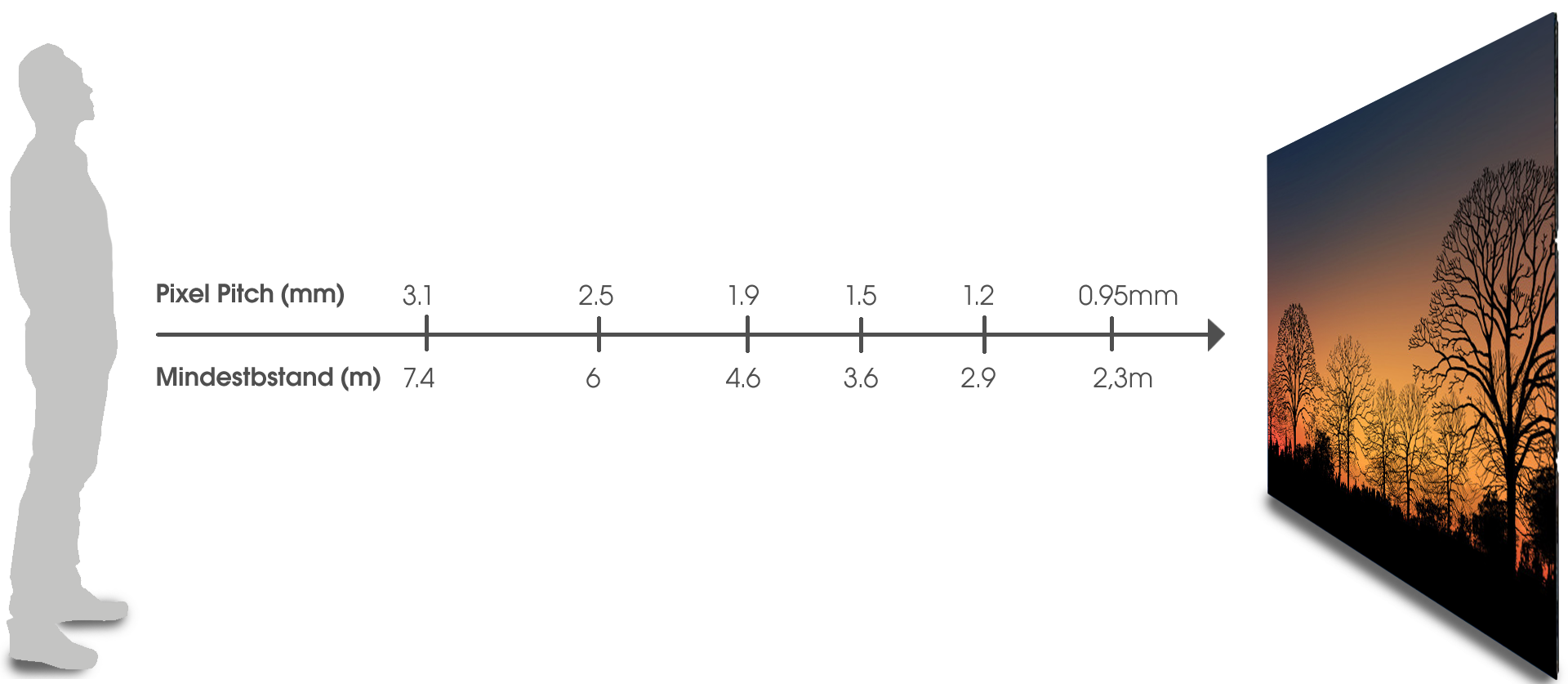
Choosing the Right Pixel Sizes
Depending on the setting in which the video wall is used, the right combination of display size and pixel spacing ("pitch") is required according to the planned distance between audience and screen. We offer displays with different pitches and advise you on all aspects of the selection.
Selection of the Right Video Controller
We rely on the proven market and technology leader NovaStar. Depending on the number of LED walls, format, resolution and redundancy concept, the selection of the video controller(s) is elementary. These must also be matched to the receiver units in the LED modules. We will advise you on extras such as brightness adjustment, HDR (High Definition Range Display) and remote connection (via fiber optics).
Making Replacement Modules Available
To ensure long-term operation, we automatically stock the appropriate quantity of LED replacement modules from the same production batch free of charge for the duration of the warranty period. They have the same color calibration in case of emergency and thus ensure an unclouded display of the entire LED wall for years! We deliver them as standard to the trained customer or system integrator.
Warranty Extensions and Insurances
The standard warranty is 2 years and in case of damage the defective part must be returned (bring-in). Of course we provide warranty extensions to 3, 4 and 5 years. We are also happy to arrange on-site service for an additional charge. This is especially recommended for store fitting, schools and semi-public buildings.
Electrical and Mechanical Planning
Depending on the size, weight and number of LED modules installed, electrical power planning, thermal design and a statically tested substructure with fixtures are required. CONCEPT can arrange suitable engineering firms and manufacturers for suspensions if required, or plan the project at a fixed price.
Arrangement of Installation and Commissioning
On request, local service partners from our network can take over the delivery, assembly, installation, calibration and maintenance of the complete LED wall – at fixed special conditions. A service that system integrators (if in-house is not possible) may also sell!
Ensuring the Operation, Service & Maintenance
Especially for LED walls that serve to display [paid] advertising, the proper function must be ensured. In cooperation with NovaStar, a maintenance software was developed that minimizes on-site service calls and significantly reduces downtime. By using it, a maintenance call can be organized automatically – before a defect occurs.
If something is not running, we take over: remotely, on site or via our service partners in the vicinity. Our customers or resellers and shopfitters do not have to worry about all the technical details.
You are currently viewing a placeholder content from Vimeo. To access the actual content, click the button below. Please note that doing so will share data with third-party providers.
You are currently viewing a placeholder content from YouTube. To access the actual content, click the button below. Please note that doing so will share data with third-party providers.
You are currently viewing a placeholder content from Facebook. To access the actual content, click the button below. Please note that doing so will share data with third-party providers.
You are currently viewing a placeholder content from hCaptcha. To access the actual content, click the button below. Please note that doing so will share data with third-party providers.
You are currently viewing a placeholder content from Turnstile. To access the actual content, click the button below. Please note that doing so will share data with third-party providers.
You are currently viewing a placeholder content from Instagram. To access the actual content, click the button below. Please note that doing so will share data with third-party providers.
You are currently viewing a placeholder content from X. To access the actual content, click the button below. Please note that doing so will share data with third-party providers.